On the first of September, three different AI labs put out three separate announcements, on the same day, without coordinating with each other. That happens often enough now that nobody in the industry blinks.
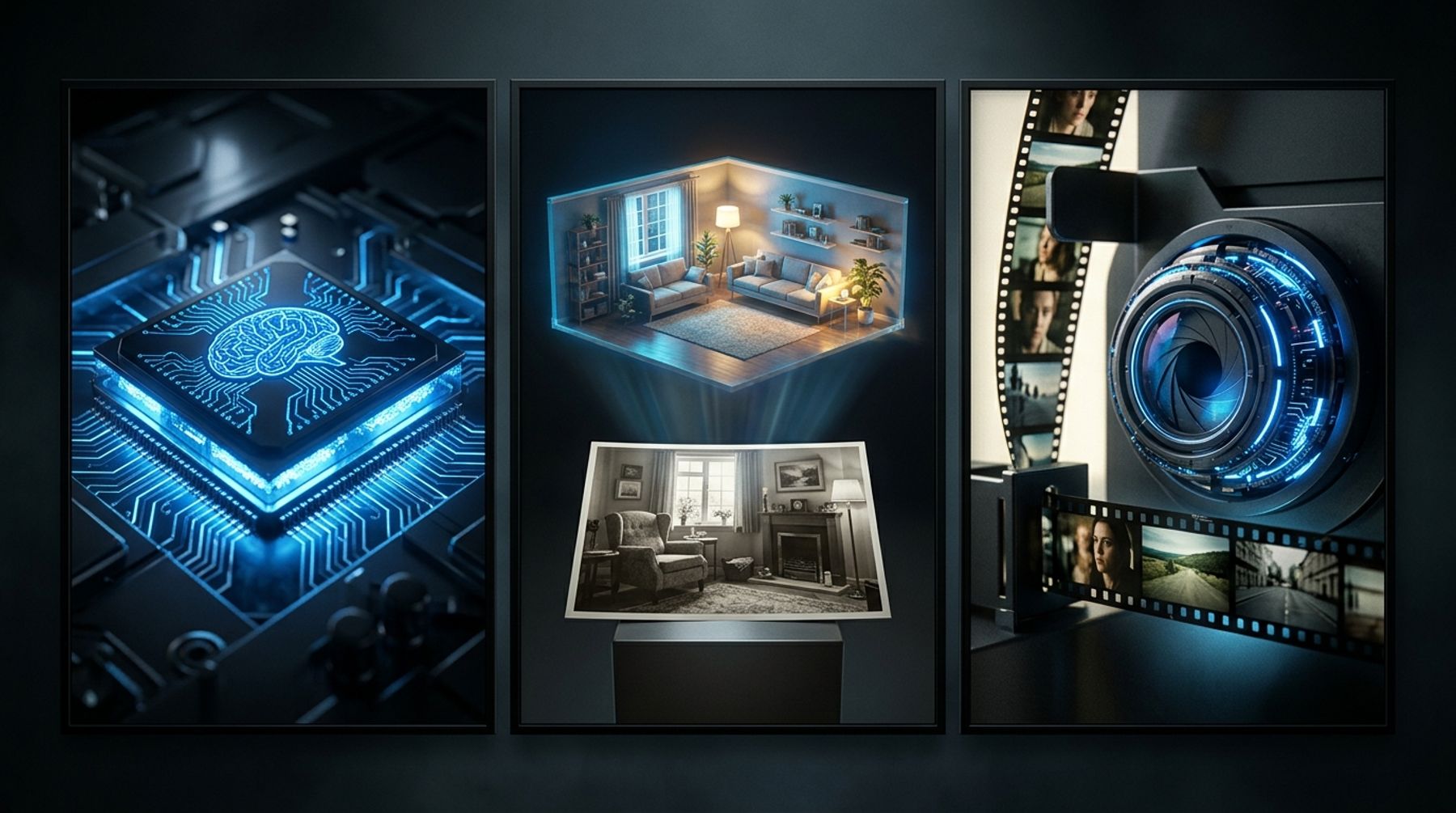
Anthropic shipped a faster, cheaper version of its frontier model. Fei-Fei Li's World Labs unveiled a model that can build and simulate entire 3D spaces from a single photo. Google quietly rewired how its Gemini models watch video.
Read as headlines, they sound like the same story: AI got smarter again. Read closely, they are three very different announcements, aimed at three very different audiences, and only one of them is worth a Ugandan business owner's attention this year. Here's how to tell them apart.
Anthropic made its agents faster and cheaper. The audience is still developers.
Anthropic's update, Claude Fable 5.1 (with a more permissive sibling called Mythos 5.1 for vetted security and life-sciences organisations), cut the cost of reading from its prompt cache by 75 percent, from $1 to $0.25 per million tokens. On top of that, its scores on agentic benchmarks jumped hard: from 24.7 percent to 52.6 percent on one science-coding test, from 17.1 percent to 31.4 percent on a general automation benchmark. Anthropic says customers used it to trace rare software bugs and run 38-hour autonomous machine-learning jobs without supervision.
That is a genuinely serious upgrade. It is also, for now, a tool for people who already build software, not for the shop owner or the marketing lead reading this. If Make It Happen's own engineers move faster on client builds because the agents they use got cheaper and sharper, that is real. It is not, on its own, something a small Kampala business changes anything about tomorrow.
World Labs' Atlas is a preview, not a product you can use yet.
Atlas is the more startling announcement of the three. Feed it as few as one to three photos of a room, a street, a building, and it reconstructs the whole space in 3D, lets you move a virtual camera through it, and can render up to a full minute of video at high resolution with precise control over where that camera goes. It can also do the reverse: generate an image or video from a text prompt and hand you the underlying 3D structure of the world it just imagined.
The obvious uses are architecture, game and film production, and robotics, where World Labs says the model can help simulate real environments before a physical robot ever moves through them. It is, in the company's own framing, an early step toward machines that understand space the way people do.
Right now, that is exactly what it is: early. Atlas is available by request only, World Labs has not published pricing, and there is no indication yet of it reaching ordinary businesses through an accessible product. File it under "watch this," not "use this."
Google's cheaper video AI is the one that actually reaches your business this month.
The Google update is the quiet one, and it is the one that matters most here. Gemini's newest models, 3.7 Flash, 3.6 Flash and 3.5 Flash-Lite, no longer watch video the same way. Instead of processing every frame at a fixed rate, they now decide what to watch, how fast, and whether to lean on the picture, the sound, or the transcript, depending on what the task needs. The result: up to 88 percent fewer tokens spent per video, costs down by up to 66 percent, and accuracy up by as much as 7 percent. It is available today, through the same Gemini API pricing, no extra fee.
Picture what that actually unlocks. A supermarket in Kampala or a warehouse in Namanve has cameras running around the clock, and almost nobody ever reviews the footage unless something has already gone wrong. A wedding or events company in Uganda ends up with hours of raw video from every job and rarely repurposes any of it. An operator running a fleet of boda riders or delivery vans has dashcam footage nobody has time to watch. Before this update, asking an AI to search that footage for a specific moment, "show me who came through the back door after closing," "find every time a rider ran a red light," was slow and expensive enough that most businesses never bothered. Now it is a fraction of the cost, and it works today, on infrastructure that already exists.
That is the difference between a lab announcement and a business opportunity. One needs no new hardware, no waitlist, and no engineering team on staff, just someone who knows what to point it at.
Pick the one that solves a problem you already have
Three labs, three announcements, one day. The industry will keep shipping at this pace whether or not any of it reaches your business. The mistake is treating every announcement as equally urgent, chasing the most impressive demo instead of the one that actually touches a problem sitting on your desk right now.
Anthropic's upgrade belongs to developers. World Labs' belongs to the future. Google's belongs to whoever picks it up first.
By Admin