Picture a hardware supplier in Ntinda who finally cracked page one on Google for "steel roofing sheets Kampala." Eight months of blog posts, a developer paid in installments, backlinks begged off two industry directories. The week he hits position one, he checks his analytics expecting a flood.
Instead, the graph is flat.
Not because he lost the ranking. Because Google didn't send anyone this time. It answered the question itself, right there on the results page, and the person searching never had a reason to click through to his site at all.
That's not a bug in his campaign. It's the new default behaviour of the world's biggest search engine, and it's already live on searches typed from a boda stage in Kampala or a shop counter in Mbarara.
The traffic isn't leaking. It's being redirected to nobody.
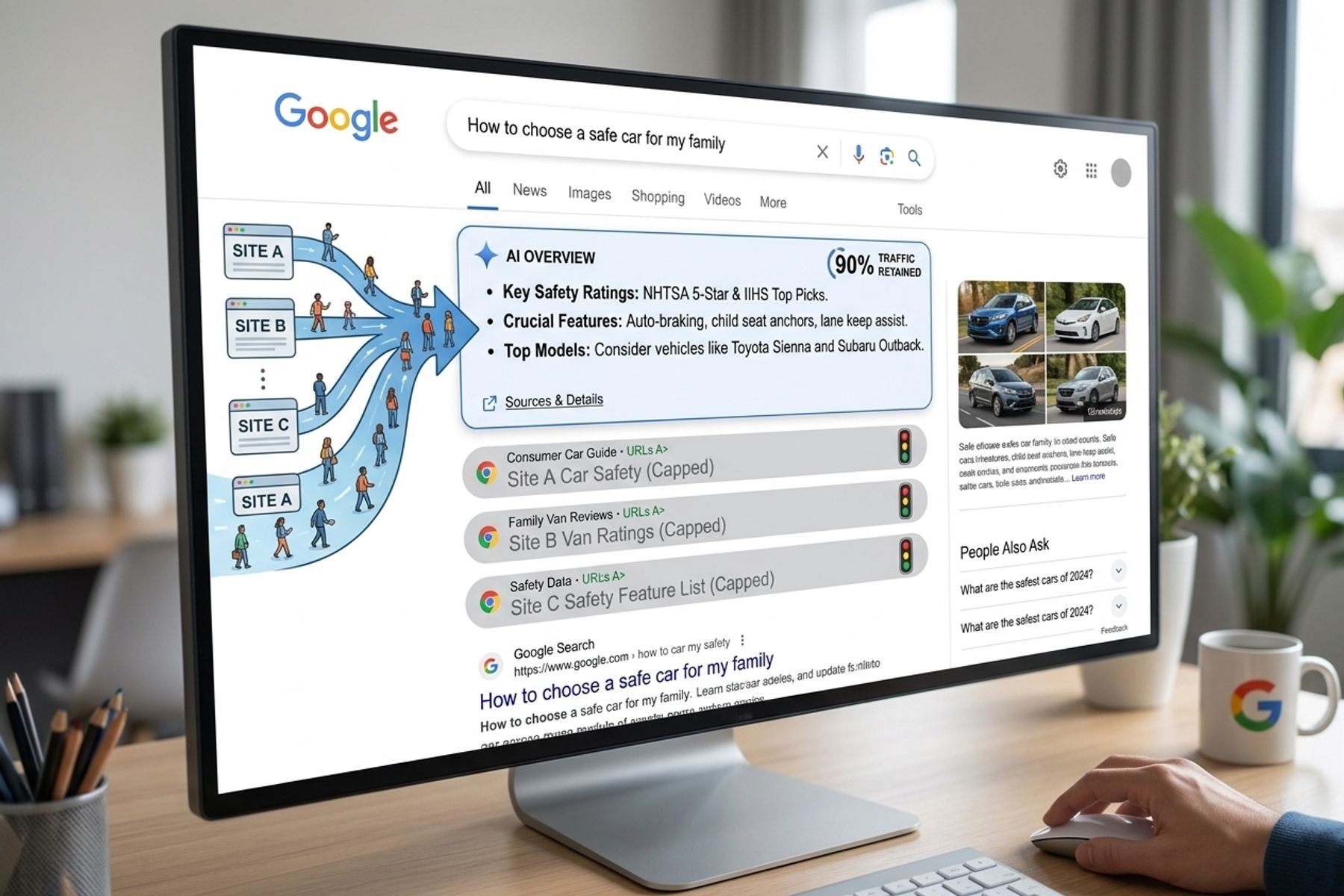
Google now answers a growing share of searches directly on the results page, using an AI-generated summary built from the same websites it used to simply link out to. Pew Research tracked this in real search sessions: when an AI summary showed up, people clicked through to an actual website in just 8% of those searches. When no summary appeared, that number nearly doubled, to 15%.
That's not a soft dip. That's close to half your organic traffic evaporating on the exact searches your marketing has spent a year chasing.
This isn't a Silicon Valley problem you can wait out. AI-generated answers on Google have been rolling out to more than 100 countries and over a billion monthly users since 2024, and this year Google pushed the same experience into 13 more African languages — Kiswahili, Somali, Amharic, Hausa among them — specifically citing "strong and growing search usage across the continent." Most Ugandan searches still happen in English, which means the AI-answer experience is already the default for the large majority of queries typed here, whether or not your particular language has its own version yet.
Uganda is walking in at exactly the wrong moment
As of late 2025, only about 11.4 million Ugandans were online — roughly 22% of the population, according to DataReportal's Digital 2026 Uganda report. Small number. Growing fast, though, and 91.6% of the mobile connections now activating in the country are broadband-capable smartphones, not the old feature-phone kind.
Which means the next several million Ugandans coming online are arriving at the exact moment search itself is being rebuilt around answers instead of visits.
For years the deal was simple: build a decent website, rank reasonably well, and Google sends you customers for free. Rent-free land, more or less, on somebody else's property.
That deal is being renegotiated without asking you. And the businesses still budgeting like it's 2022, pour money into ranking, wait for the clicks to arrive, are going to find out the terms changed from a flat traffic graph, not a memo from Google.
What actually protects you from this
Not panic. Not abandoning your website. Two things, done properly.
Write to be quoted, not just ranked. AI summaries are still built from web content, and specific, well-structured pages that answer a question directly still get pulled into that summary and cited even on the searches where the click never comes. Vague copy ("we offer quality roofing solutions") gets ignored by the algorithm the same way it gets ignored by a human skimming for an answer. A page that states plainly what you sell, what it costs, and who it's for still wins. It just wins through citation and trust now, not a guaranteed click.
Build a channel Google can't switch off. A WhatsApp Business line customers actually message. An email list you own outright. A community that comes back to you directly, not through a search box you don't control. None of that depends on an algorithm deciding, this week, to send someone your way.
A website built only to be found is now a website built on borrowed ground. A website built to be found and to convert whoever it gets, directly, into a relationship you own, that one survives whatever Google does next.
For years, the goal was to get found by Google.
The goal now is to be worth finding without it.
If you're not sure which kind of website you're running, that's worth finding out before a competitor does. Get in touch, and we'll take a look.
By Nasif K Balinda